
Minseok Kang “This Is Not Ice Cream” Loop Lab Busan 2026 Exhibition
- KangCar
- Apr 19
- 4 min read
Updated: Apr 20

The exhibition is titled “Emotion Does Not Stop. Memory Does Not Stay Fixed.” and features two artists, Minseok Kang and JaYong Park. The framework of Minseok Kang’s space is structured under the concept “This Is Not Ice Cream.” The exhibition runs from April 21 to May 2, 2026 at Art Lab. It begins from the idea that emotions and memories are not fixed, but continuously reshaped through time, environment, and media.
To understand Minseok Kang’s work, it is important to consider why he began collecting fragments of paint to form ice cream shapes. These forms are not simply playful or decorative objects. In his artist statement, Kang explains that he created ice cream using leftover paint, not as a light object, but as a condensation of passing memories and emotions. If painting captures tension, conflict, and intensity, the ice cream emerges from what remains afterward. It is not an external image, but a reorganization of material left behind in the process of painting. For Kang, paint is not just a medium, but a trace of time and emotion that accumulates, hardens, and reappears as a familiar form.
The choice of ice cream is closely tied to this idea. Ice cream represents something sweet yet temporary, something that melts and disappears. It contains the sense of fleeting joy and passing time. Kang captures this disappearing sensation within a stable form. However, his works are not ice cream. They do not melt, cannot be consumed, and have no physical sensation such as taste or temperature. What remains is only the appearance. This is where the statement “This Is Not Ice Cream” becomes central. It is not simply a denial of an object, but a challenge to the way we trust what we see. It extends into a question about memory itself, suggesting that what we believe to be real may already be a reconstructed and distorted form.
“This Is Not Ice Cream.”
Kang’s space begins at the entrance. Before entering the room, the viewer encounters three structures simultaneously: an interactive device on the left, a sculptural installation on the right, and three vertically positioned 50-inch screens visible inside the room. This arrangement reflects the layered structure of memory—image, intervention, and material perception existing together. The viewer does not approach the works one by one, but first absorbs the entire visual field and then experiences each layer individually. This exhibition does not rely on long viewing time, but instead creates a strong and immediate impression that lingers afterward.
At the center, three screens display rotating images of ice cream forms. These shapes are based on familiar, everyday ice cream types. Importantly, they are not digital simulations. Kang constructs each form using acrylic paint and records them by suspending and rotating them in a controlled studio environment. What appears on the screen is not a virtual image, but a recorded trace of physical material. However, in the exhibition space, sound is removed, leaving only visual perception. At this moment, viewers instinctively recall taste and sensory experience. Even without physical consumption, memory reconstructs the sensation. The work does not provide sensation directly, but triggers it through memory.
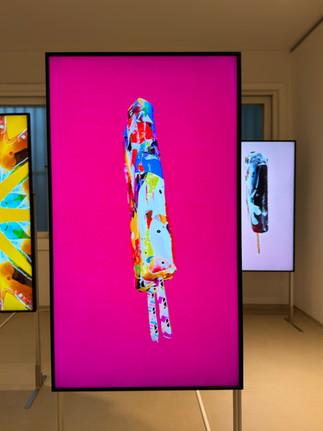

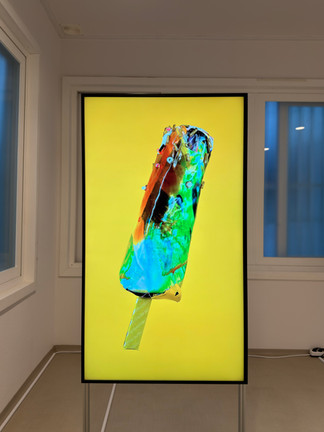
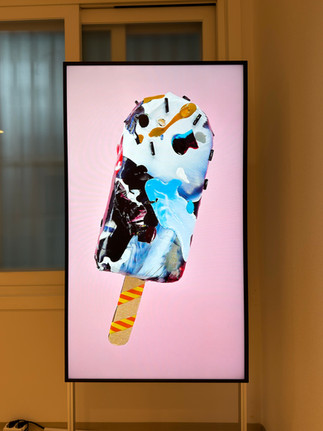
The titles of the works function in the same way. Rich Strawberry & Milky Cream, Sweet Melon Mango Popping, Sparkling Lemon Soda Cool are not descriptions of new flavors, but triggers that recall familiar sensations already stored in memory. The works operate as visual forms and, at the same time, as devices that activate personal memory.
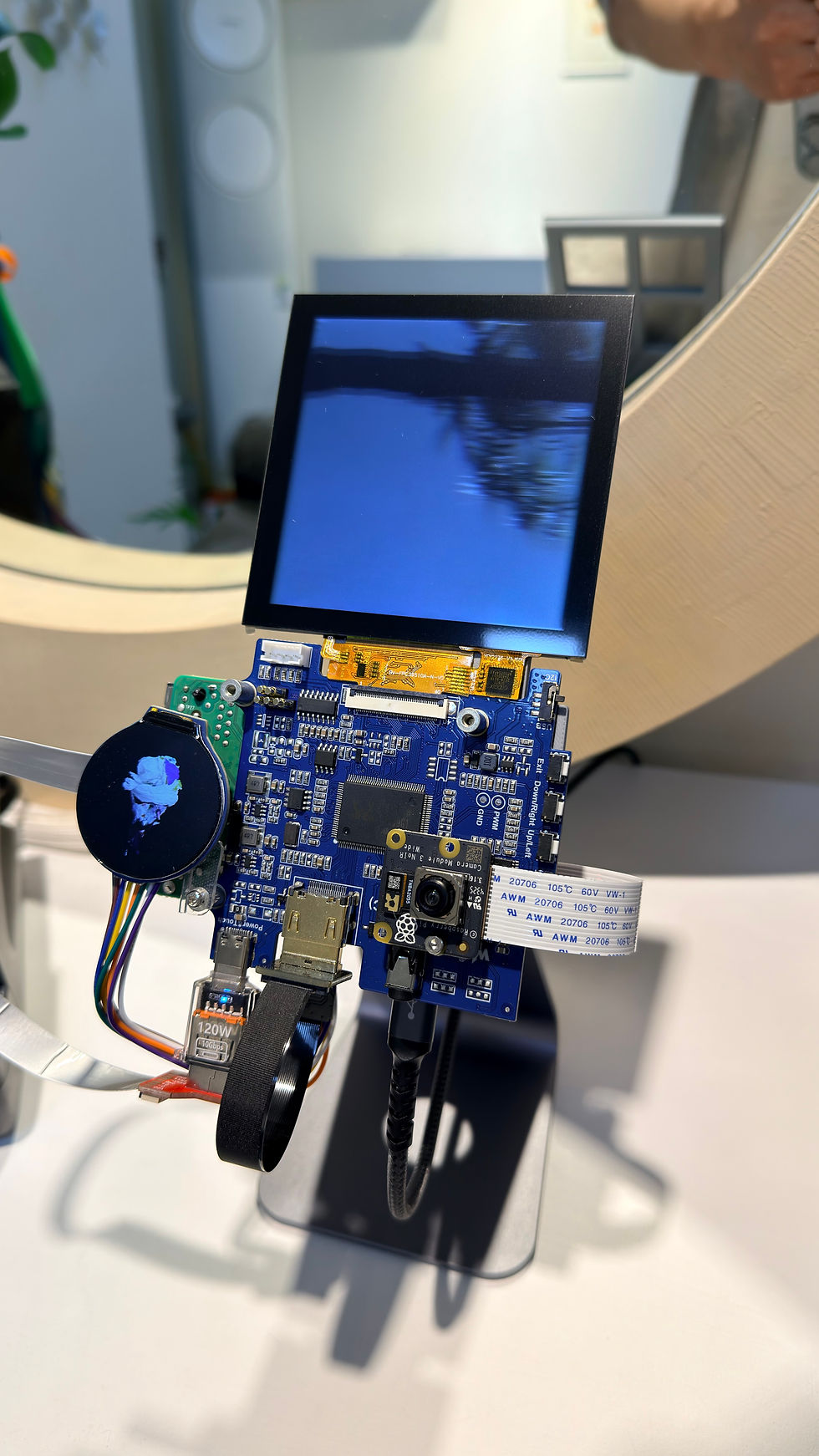
The interactive piece, “Ice Cream Made by Memory,” makes this process more explicit. It begins with ordinary video and randomly rotating ice cream images. When the viewer makes a gesture, the video reverses, desaturates, increases in contrast, and becomes visually distorted. At the same time, one image is selected and fixed, then combined with fragments of reversed footage to form a final image. This reflects how memory functions—not as a perfect record, but as a process of selection, omission, and reconstruction. The work allows this process to unfold in real time through the viewer’s interaction.

The installation on the right, “The Form of Memory Emerges Faintly,” reveals the gap between physical reality and perception. A sculptural form is placed inside an acrylic tube, distorted by water and a special film. The viewer knows the object exists, yet what is seen is a blurred and altered image. This image is not fixed, but changes depending on the viewer’s position. It is not a stable form, but a shifting perception. This work shows that even when something physically exists, what we perceive is always mediated and incomplete.
What makes Kang’s work compelling is that it addresses complex ideas through a familiar and accessible form. Themes such as memory, perception, and reality could easily become abstract, but the use of ice cream creates an immediate connection. Viewers approach the work with simple reactions, but gradually their perception is disrupted. This is why “This Is Not Ice Cream” becomes a strong statement. It begins with familiarity and ends with doubt, revealing that what appears real may already be a constructed and altered image, much like memory itself.
In conclusion, “This Is Not Ice Cream” is not an exhibition about ice cream. It begins with fragments of paint, transforms them into sculptural forms, and expands them into video, interaction, and installation. Through this process, it reveals how emotions and memories take shape and how they become distorted over time. What remains after the experience is not the image itself, but a question: how much of what we see is actually real, and how much is constructed through perception and memory.
Exhibition Information
Exhibition Title: Emotion Does Not Stop. Memory Does Not Stay Fixed.
Participating Artists: Minseok Kang, JaYong Park
Minseok Kang’s Section Title: This Is Not Ice Cream
Exhibition Dates: April 21 – May 2, 2026 (Closed on Sundays and Mondays)
Viewing Hours: 1 PM – 5 PM
Venue: Art Lab, 1F, 61-4 Mangmibeonyeong-ro 63beon-gil, Suyeong-gu, Busan
Contact: +82-10-3598-5042
Email : artlabkorea@naver.com
Instagram: @artlab_korea / @artlabbusan @kangcar




AI Docent


Comments