
On Things That Cannot Stop
- KangCar
- 2월 10일
- 3분 분량
I have always lived with anxiety about the future. Looking back, that anxiety was not simply a matter of personality or mood, but something rooted in years of living without being able to explain to myself the things that cannot stop. I began drawing at a young age and grew up being told that I was good at it, supported by those around me. Choosing art felt natural. Yet the Korean entrance exam system was harsher than I had imagined, and I grew exhausted by the process. I failed to enter an art college at the time I had hoped, and that experience felt less like a single failure than the moment when my entire sense of certainty began to shake.
Around that time, I met a mentor. I had already fully learned the techniques and skills required for entrance exams, but he was the first person to suggest that another path was possible. Returning to school through transfer admission became a realistic option for the first time. In this way, I arrived here not by following a single path that everyone walks, but by passing through many uneven turns. Those years were neither fast nor smooth, yet they unmistakably passed through me. Through that process, I gradually became aware that I was living in a state of constant movement—unable to stop.
Learning art ultimately means learning technique. Yet I could neither fully trust technique nor completely reject it. I had learned it, so I had to use it; the more I used it, the more I wanted to escape from it. But erasing what had already settled into the body was not easy. Technique supported me, while at the same time binding me. Within that contradiction, I continued to waver, always being pushed forward, rarely able to stop.
I spent my twenties and thirties in this unstable state. Even after graduating from undergraduate school and entering graduate studies, I could not clearly define myself. The question of “What kind of person am I?” weighed heavier than “What do I want to paint?” At home, there existed another world of standards. My siblings were all engineering students, valuing precise data, clear results, and definitive answers. Vague adjectives and ambiguous emotional language were not easily trusted. Growing up in that environment, I too became someone who sought reassurance through what could be proven, rather than enduring what could not be explained.

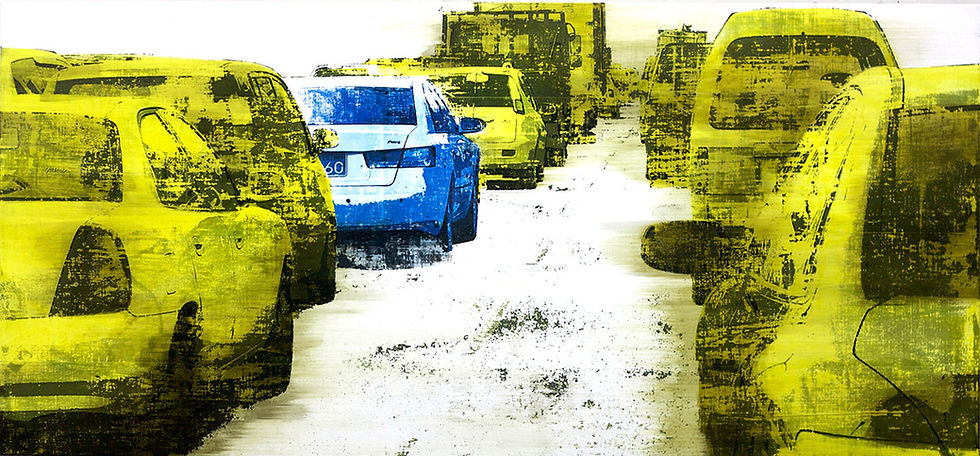
One day, while driving, I stopped at a red light. On a wide eight-lane road, countless cars stood in rows, all heading somewhere—toward schedules, destinations, obligations. They were not glamorous or symbolic like the cars I paint today. They were simply vehicles in motion, cars that had to keep going. In that crowd, I realized that I was one of them. And in that moment, a thought occurred to me: have we all become too accustomed to things that cannot stop?
That question marked the beginning of my car paintings. Cars were no longer simple objects to me. They became my condition, my anxiety about the future, the pressure that tells me if I stop, I will fall behind. That is why the cars in my paintings are always unstable. They are distorted, fragmented, reduced to speed while losing direction. I scrape, push, and let paint flow across the surface. When I drag a squeegee across the canvas, the image briefly escapes control. By drawing straight lines and stitching across the surface with thread, I am not trying to display technique, but rather to expose the self that has been unable to stop clinging to it.
I am still anxious about the future. That anxiety does not disappear easily. But now I understand this: what I am painting is not speed itself, but the act of questioning things that cannot stop. We all pause at a signal and then start moving again, whether our direction is clear or not. If so, what truly matters may not be how fast we move, but why we have been unable to stop—and whether we are willing to keep asking that question.